


September 7, 2026
The new balance: Why tomorrow’s talent needs both essential skills and AI capabilities


Hiding away in plain sight is a problem that few people are talking about – AI weakens our skills when we overuse it. And this is particularly significant for children, and for young people about to enter the workforce.
The very human desire to make life easier means many young people are rapidly losing opportunities to develop the essential skills they need to succeed in their future careers. And that’s bad news for the organisations ready to recruit bright, fresh talent.
What does the current AI landscape look like for young people?
Technology and youth go hand in hand. You may not be surprised to learn that 79% of young people regularly use AI in apps like Snapchat and tools like ChatGPT. Young people are streets ahead of adults in this respect, with just 52% of businesses using AI.
Yet the way young people use AI is haphazard and hasn’t been facilitated by formal education. Even with the recently announced curriculum changes, many children won’t be taught about AI until 2028. Teachers recognise that this is a problem - 76% of educators told us they lacked confidence in discussing the skills needed in an AI workplace with students.
We believe there’s a unique opportunity for employers to step into this skills development gap. By working with schools, they can futureproof tomorrow’s talent by guiding young people to become AI-capable and AI-responsible.
Introducing the AI paradox
To truly understand the challenge for employers and the young people joining the workforce, we need to step back. Technology is taking on more mundane, process-based tasks. As it does, employers increase their need for human skills such as judgement, contextual understanding and communication. Take a look at any job board and you’ll see most postings still emphasise behaviours over specialist AI skills.
These human skills take time and effort to develop and are the result of experience, not repetition. That’s why work experience and workshops are so effective at helping young people develop essential skills.
AI is so frictionless and effective that we ask it to do more than handle routine tasks. We use it to ease our overworked minds by taking on more challenging tasks. Whether it’s turning your research findings into a report or deciding where to go for dinner, repeated AI usage makes life easier. But there’s the problem: in so doing, it chips away at our uniquely human skills.
There’s already evidence that frequent AI usage reduces cognitive function. A study of nearly 1,000 students showed that those using ChatGPT to solve maths problems initially outperformed their classmates by 48%. However, when they were tested without access to AI, their scores dropped 17% below those of their peers.
Whether or not AI make us stupid is not yet clear, but it certainly makes us more tech-dependent. Young people who have had fewer opportunities to develop higher-order skills are especially at risk.
Futureproofing tomorrow’s talent
To nurture the leaders of tomorrow, we must support young people to develop skills that complement their technical capabilities. Many students lack these hard-to-develop skills – critical thinking, problem solving and creativity – as a result of their inexperience. How can we, as employers, educators and parents, ensure future generations develop these essential skills when everyday technology appears set to diminish them?
Like everyone, we’re continuing to learn about AI education here at Connectr Early Engagement. Our work supports young people - particularly those from disadvantaged backgrounds - to develop skills-based resilience for the future workplace.
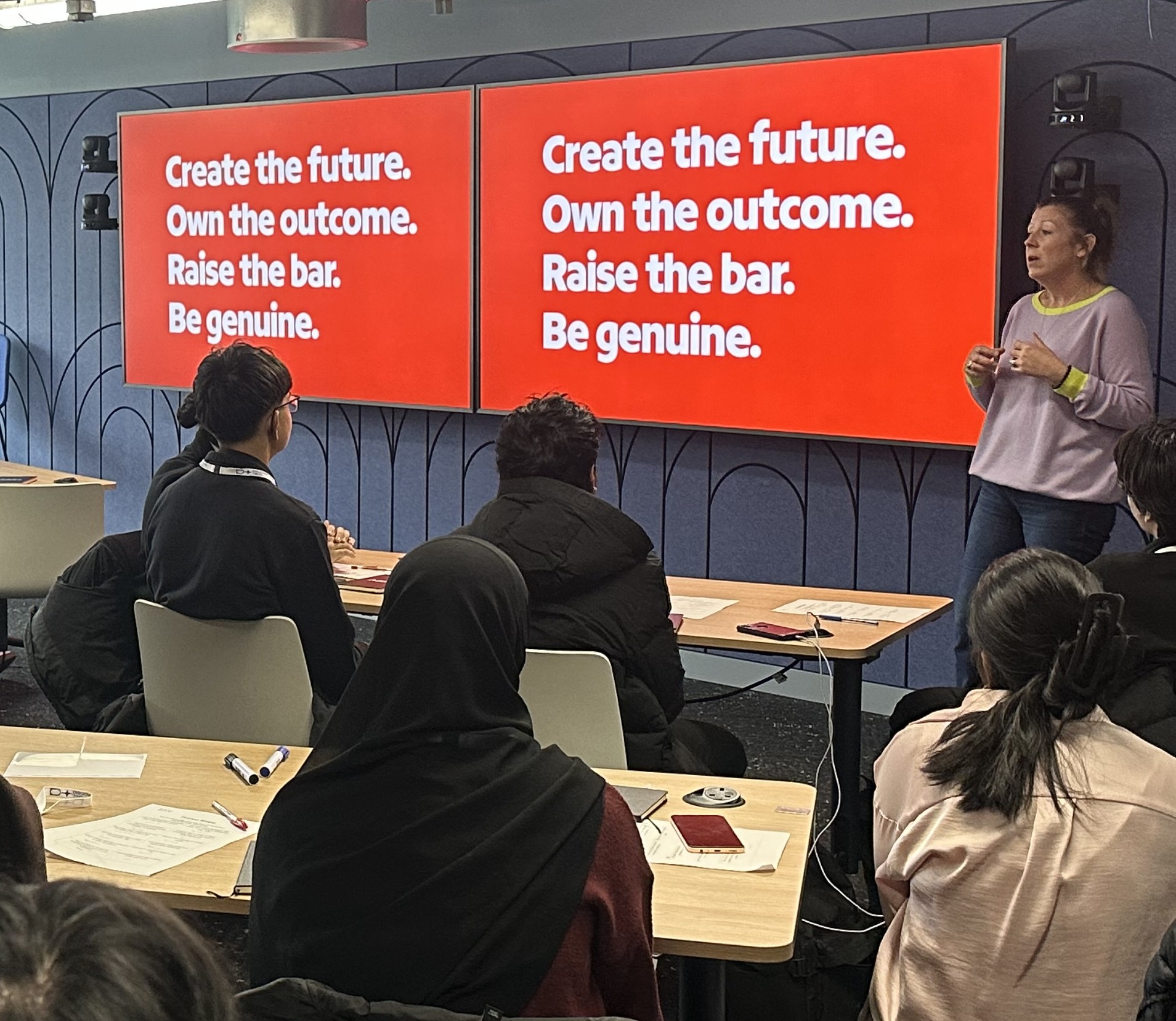
"The workshop struck a perfect balance between theory and practical learning, and the students thoroughly enjoyed the experience. A huge thank you to Connectr and Grain LNG for delivering such a valuable and inspiring session!" - Carey Noble, Head of Science. Maritime Academy, talking about our Grain LNG Insight Day
What’s the situation in schools?
Current AI adoption in schools depends heavily on individual teacher enthusiasm and school resources. Years of budget constraints mean many state schools lack the capacity for strategic AI integration, even when educators recognise its importance.
Early research already shows that those who use AI regularly earn over £8k more each year than their peers. Without intervention, an inadequate AI-related education will become another systemic inequality affecting those from the most disadvantaged backgrounds.
How can employers support educators and young people?
We believe employers are in a unique position to steer AI education in a direction that supports future workplace needs. They have the workplace context, real-world use cases, and understanding of which skills matter in professional settings. As yet, few teachers have sufficient practical experience to provide this depth of support.
Crucially, organisations don’t need to be technology-focused for this to be relevant. Here are the three most important ways we believe employers can support educators and young people:
- Integrate it into careers education
Careers education is already a significant element of many early engagement programmes. This makes it the ideal vehicle for light-touch AI guidance.
Crucially, this doesn’t mean adding AI-specific training to an existing engagement schedule. Instead, it’s about infusing AI into existing topics, especially those that require critical thinking skills. For example, teaching young people to use AI to support the way they write a CV, or sharing how they could use AI to strengthen their interview technique.
Discover Tech is a real-life example of how AI-related development can be incorporated into engagement activities. It includes employer insight days and facilitator-led skills sessions laced with AI applications and demonstrating how to use AI responsibly.
- Support essential skills development
Many of the skills influenced by AI usage are already a focus for educators. This means that instead of creating something new, employers can support what already exists, for example:
- Share real-life examples of how your organisation uses AI and explain how your teams use AI applications to supercharge their talents, not replace them. Techniques such as using AI for Socratic thinking or critical evaluation help students develop essential skills, supporting academic results and future careers.
- Demonstrate your organisation’s ground rules for AI usage. This highlights the nuance of using AI responsibly. One client told us about their ‘traffic light’ system for AI usage. For instance, drafting a report is a ‘Red’ (do not use AI), whereas proofing your almost-complete document allows ‘green’ (free rein for AI). Used in this way, individuals continue to cultivate their ‘human’ skills such as judgement and problem-solving while saving time on onerous technical tasks.
- Get practical and support resource development
Basic AI training and development can help schools level the playing field for disadvantaged students. Consider asking your partner school what support they’d find helpful. This could result in hands-on opportunities that are easy to deliver yet have a significant impact. For example:
- Supporting SLTs to create an AI usage policy
- Supporting privacy and ethics concerns, where appropriate
- Training staff on effective prompting skills
- Partnering with in-school AI champions
- Brainstorming sessions to highlight potential use cases.
(Find out more about our work with Deloitte on their 'Trustworthy AI in Education' programme.)
Ultimately, this isn't about employers teaching young people how to use AI. It’s about co-creating pathways that prepare young people for AI-integrated workplaces while building the essential human skills that will define career success.
What’s next?
Engaging with young people to support AI-related skill development is an opportunity that’s there for the taking.
AI’s introduction may feel swift, but we’re only beginning to understand its potential. Together, we can support and inspire a generation to seize and shape the future – regardless of their background.
We believe it’s time to connect young people, educators, and employers, to steer the AI revolution toward something that’s universally positive. When we combine technology with empathy, curiosity, and collaboration, the future looks bright.
Speak to Rachel Morar to find out more about what we do, and how we've been supporting schools, employers and teachers to make sure AI can level the playing field for young people starting their careers and not widen the social mobility gap in the UK further.

Thank you! Your submission has been received!
Oops! Something went wrong while submitting the form.
Thank you! Your submission has been received!
Oops! Something went wrong while submitting the form.
"I learned that essential skills are key to gaining the hearts and minds of employers to get a job."



Empowering Futures Starts with You