

September 23, 2026
How Softcat turned work experience into a talent-spotting opportunity


When Early Careers Recruitment Manager Tia Bradley took responsibility for work experience at Softcat, she saw an opportunity to do things differently.
Softcat’s existing model involved two week-long placements each year with longstanding school partners, typically reaching eight to ten students at a time. It required considerable employee time without a clear link to the organisation’s wider early-careers recruitment goals.
Tia wanted work experience to work harder by reaching more young people without increasing the resource required from the business, focusing that reach on students from lower socioeconomic backgrounds and, ultimately, creating routes into Softcat’s apprenticeships and other early-career opportunities.
Discover Tech offered a way to put that thinking into practice.
When future talent stood out
One moment showed exactly what that could look like.
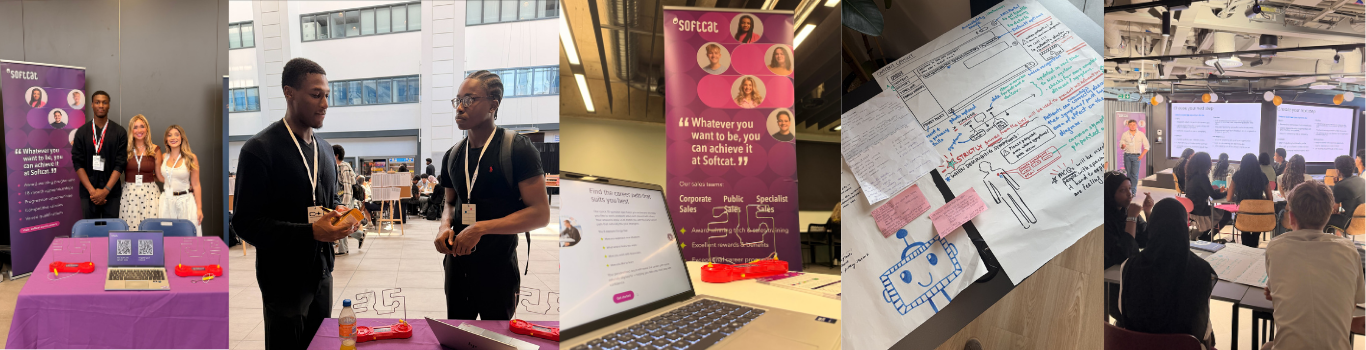
On day two, students hosted at Softcat were challenged to develop an idea for an AI chatbot for the healthcare sector before pitching it to a judging panel. Tia deliberately invited senior colleagues onto the panel whose remit includes AI.
What the students produced took them by surprise. Two groups went beyond expectation by developing an idea into a prototype. One had even built a website around its concept. They had done it alongside preparing their wider pitches.
As one of the students presented, one colleague turned to Tia and said, “My mind is blown that they have done that in an hour and a half.”
He was considering taking on apprentices the following year and asked Tia to keep an eye on two of the students involved in developing the prototypes. Afterwards, Tia approached them, encouraged them to register their interest in future Softcat opportunities and suggested they connect with her colleague on LinkedIn. Both did.
For Tia, it was a particularly satisfying moment. A senior colleague who had never previously had early-careers talent in his team was suddenly thinking differently about what an apprentice could bring.
Rethinking early-careers talent
The students’ technical capability surprised Tia too.
“We know that the younger generation are more digitally savvy, but you see it then and there in plain sight and you’re like, ‘Hang on, how do they know how to do that?’”
For Tia, it reinforced the value that younger employees can bring to established teams.
“There is real benefit in early careers talent. It doesn’t always mean you’re going to have to bring someone in that’s completely green and teach them everything. They can really teach us as well.”
And London wasn't the only time Softcat saw that potential. At Discover Tech Manchester, a senior salesperson working in healthcare was also struck by the quality of the students' ideas, remarking on how relevant some of them would have been to recent customer conversations.
Technical skills are only part of the picture
Being able to build an AI prototype wasn't enough to win the challenge.
Although Softcat operates in technology, many of its roles are customer-facing. Employees need to communicate well, build relationships and explain ideas clearly. The judging reflected that. Students used presentations, storytelling and even role play to bring their ideas to life.
“As the salespeople in the organisation, we were like, ‘You’ve got me. I’m hooked.’”
For Tia, that combination of skills is impressive. She sees young people who are highly digitally capable but can find the face-to-face demands of interviews and workplaces harder to navigate. Across the two days, students practised both – networking with people they didn't know, working in new teams and building towards their final presentation.
Seeing what an application can’t show you
For employers, that creates another opportunity to seeing potential before a young person ever reaches an interview.
“You get to see how they’re acting in a professional environment. How are they working as a group? How confidently are they delivering? What is the technical capability there? There’s nothing that can beat seeing someone and having them live in that session.”
At a recent roundtable with other early-careers employers, Tia heard the same challenges repeatedly: organisations are receiving more applications, candidates can apply for large numbers of roles and employers need ways to build a more engaged pool of potential recruits.
From more applicants to more invested applicants
Before Discover Tech, some of the students Tia spoke to had never heard of Softcat. By the end, several were considering applying.
Having spent time in the office, met employees and experienced the culture for themselves, those who later apply will have a clearer idea of what they're applying to.
“They’ve been in the office, they’ve felt the culture, they’re then invested in comparison to candidates who are applying for 100 jobs and don’t really know who you are.”
That experience can also help young people when they reach an interview. Candidates at the beginning of their careers often struggle to find examples that demonstrate their skills. Someone who has taken part in Discover Tech can talk about working with unfamiliar teammates, developing an idea under time pressure, presenting to senior employees and responding to a real business challenge.
“They automatically have more to talk about. The hiring manager will feel this person is more engaged and for me, the benefit is hopefully the hiring manager will hire them because it’s a better interview.”
Making work experience work harder
Employers increasingly see the value of work experience as a recruitment tool but delivering it at scale can be difficult when early-careers and HR teams have limited resources.
Softcat continues to run its own work experience activity alongside Discover Tech. For Tia, the two work in tandem. The ambition is ultimately that some of the young people Softcat meets through work experience return – whether as apprentices, placement students, interns or graduates.
The connections made at Discover Tech offer an early glimpse of how that can happen. Two students demonstrated their potential in front of a senior leader, were encouraged to stay connected with Softcat and left with a possible route back into the organisation.
And, on the other side of the judging table, a senior leader left with a different idea of what early-careers talent could bring to his team.
Could your organisation benefit from Discover Tech?
Discover Tech gives employers the opportunity to meet and identify young talent before recruitment begins, while giving students the experience and insight to make more informed choices about where they apply.
Get in touch with Rachel Morar to find out how your organisation could take part in Discover Tech or explore a similar programme for your industry.
.png)

Thank you! Your submission has been received!
Oops! Something went wrong while submitting the form.
Thank you! Your submission has been received!
Oops! Something went wrong while submitting the form.
“They’ve been in the office, they’ve felt the culture, they’re then invested in comparison to candidates who are applying for 100 jobs and don’t really know who you are.”



Empowering Futures Starts with You